Metals fail
At temperatures above 1,000 °C, softening, oxidation or creep deformation begins.

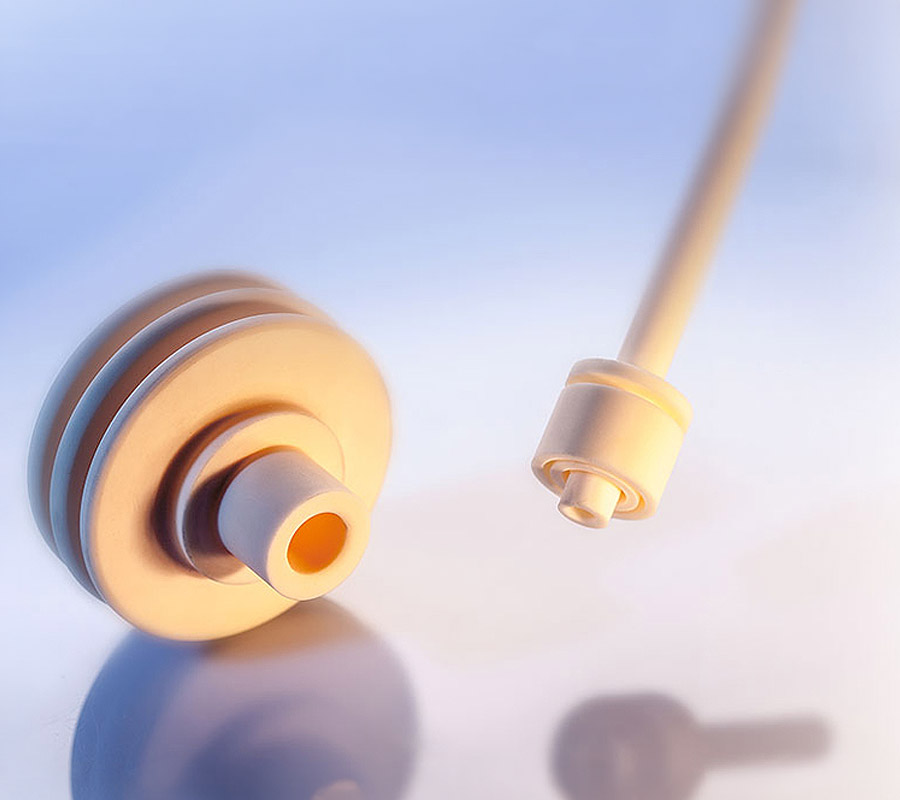
Temperatures beyond 1,000 °C place sustained demands on most metals that they cannot withstand without limitations. Technical ceramics withstand operating temperatures up to 1,750 °C. They remain dimensionally stable – no softening, no flow – even in vacuum and under oxidising conditions.
View typical requirements
Dimensional stability, vacuum compatibility, chemical purity – the key requirements in high-temperature applications.
Select material by application
Al₂O₃, SiC or Si₃N₄ – decision guide based on temperature, atmosphere and mechanical loading.
Discuss a specific component
Crucible, protection tube, calibration body? We clarify feasibility in a direct conversation.
At temperatures above 1,000 °C, softening, oxidation or creep deformation begins.
Even temperature-resistant alloys oxidise under sustained loading above 1,000 °C.
Metals soften and flow – dimensional stability can no longer be guaranteed.
Crucible materials can release trace substances that distort analytical results.
Many materials outgas in ultra-high vacuum at temperatures above 1,000 °C.
Tell us your operating temperature, atmosphere and required purity level. We assess the material and feasibility.


Clarifying operating temperature, atmosphere and purity requirements early avoids selecting the wrong material for series use.
Up to 1,750 °C
Operating temperature of oxide ceramics – where metal softens or oxidises.
99.95 % Al₂O₃
Achievable purity for crucibles and analytical components in mass spectrometers and DTA instruments.
Dimensionally stable
No softening, no flow – even under sustained load at extreme temperatures.
From batch size 1
Manufacturing without minimum quantities – prototypes in the same process as series parts.
ISO 9001
Certified process with full documentation available on request.
Answers to typical questions on temperature resistance, purity requirements and the feasibility of ceramic components.
Which material withstands temperatures above 1,000 °C on a sustained basis?
Al₂O₃ is the standard material for continuous operation up to 1,750 °C – dimensionally stable, oxidation-resistant, available in purity grades up to 99.95 %. For temperatures above 1,600 °C combined with high mechanical loading, SiC or Si₃N₄ come into consideration. The decisive factor is not only the peak temperature but the sustained load and the operating atmosphere.
What must be considered for crucible materials in high-precision analytical instruments?
For mass spectrometers, DTA instruments and effusion sources, purity grade and material release are critical. Al₂O₃ at 99.95 % purity releases no trace substances that could distort measurement results. We also manufacture custom special solutions: ground-fit lids, bores, threads and metallisation of crucible bases.
Can ceramic components be used in ultra-high vacuum?
Yes. Oxide ceramics such as Al₂O₃ and ZrO₂ are (ultra-)high vacuum compatible even at temperatures above 1,750 °C – no outgassing, no contamination of the system. BCE specifically manufactures high-temperature components for UHV systems.
Which ceramic components does BCE manufacture for high-temperature applications?
Analytical crucibles for mass spectrometers and DTA instruments, effusion crucibles, Knudsen cells, high-temperature components for UHV systems, calibration bodies for thermal measurements in furnace construction, electrical insulators and protection tubes. All components manufactured to customer drawings; custom special solutions available on request.
How reliable are ceramic components in sustained high-temperature operation?
The decisive factor is the probability of failure under the specific load profile – operating temperature, atmosphere, mechanical load and thermal cycles. When these parameters are carefully matched to one another, a very low failure rate is achieved. Failures almost always result from incorrect material selection or from underestimating sustained loading relative to the peak temperature.
We will tell you which material performs reliably in your atmosphere and at your temperature.