Project InCoker

BCE SPECIAL CERAMICSResearch and development for technical ceramics

BCE participates together with companies, universities and research institutes in selected development and research projects.

The focus is on ceramic materials, demanding component geometries and manufacturing processes that cannot be adequately mastered with existing solutions. The findings gained are incorporated into material selection, component development and production planning at BCE.

RESEARCH WITH PRACTICAL BENEFITWhy BCE brings manufacturing experience into research projects

A ceramic material that achieves the required properties in the laboratory is not yet a manufacturable component. Between material sample and reproducible production, geometry, process control and testing determine whether a research result becomes a reliable part.

BCE Special Ceramics contributes its practical manufacturing experience to research and development projects: from selecting and processing ceramic materials to manufacturing test parts and evaluating results under real production conditions.

We focus on three areas:

Advancing ceramic materials

Developing load-appropriate component geometries

Optimising and digitally modelling manufacturing processes

RESEARCH AND DEVELOPMENT PROJECTSSelected research and development projects

The following projects illustrate how BCE investigates new materials, design principles and manufacturing processes. They include completed research consortia as well as current development tasks whose technical feasibility is still being established.

PROJECT IN PREPARATION

High-pressure resistant ceramic crucible

Experimental development for pressure loads up to 3,000 bar

BCE is preparing the experimental development of a single-ended closed ceramic crucible designed to withstand pressure loads up to 3,000 bar. A potential application area is high-pressure NMR, where materials and components must function reliably under extreme pressure conditions.

The technical challenge lies in the interplay of ceramic material, component geometry and manufacturing process. In particular, the closed crucible base, the transitions to the wall and possible manufacturing-related defects influence the load-bearing capacity of the component.

The project aims to select suitable materials and geometries, manufacture test parts and evaluate them through pressure testing. The goal is to develop a reliable technical basis for ceramic high-pressure components where established materials or existing design solutions are insufficient.

An application for the German tax research incentive is planned for this project.

Project InCoker

DURATION: 2021 TO 2024

InCoKer

Digital development of ATZ and ZTA ceramics

The InCoKer research project investigated how ceramic materials and their manufacturing processes can be developed and optimised more effectively using digital methods.

The focus was on ATZ and ZTA ceramics. BCE contributed its experience in the processing, manufacturing and practical evaluation of ceramic test parts.

The findings help to identify relationships between material composition, manufacturing process and subsequent component properties at an earlier stage.

Superbolts - BCE Special Ceramics

DURATION: 2014 TO 2016

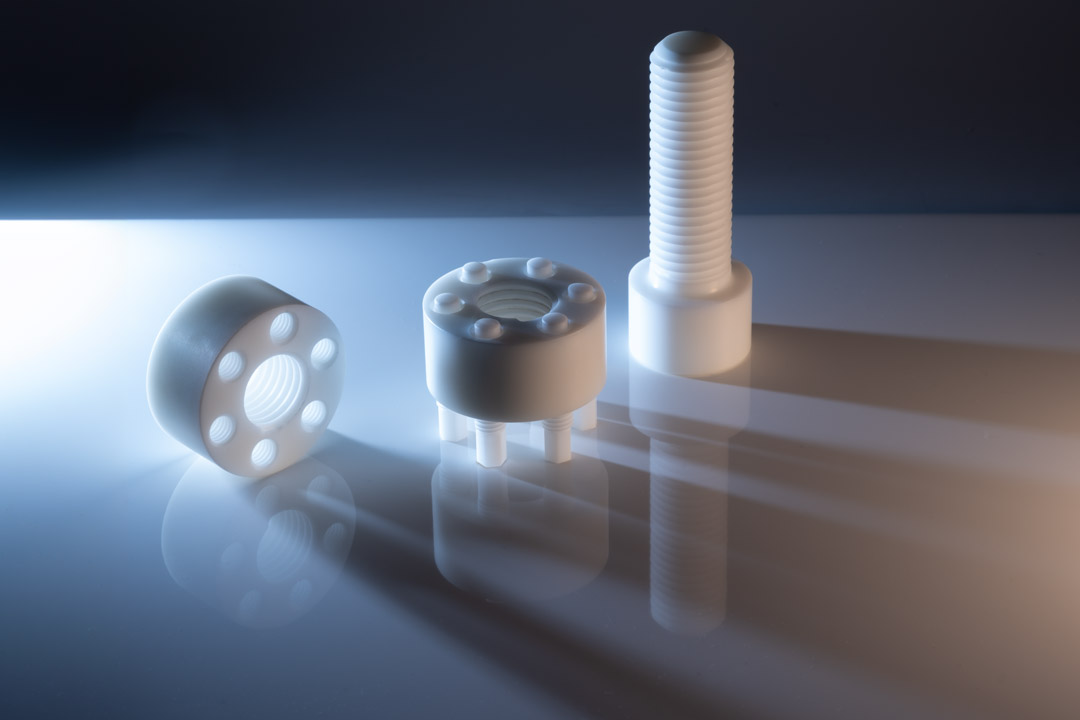
Ceramic screw connections

Ceramic joining solutions for extreme operating conditions

This research project addressed ceramic screw connections for applications where metallic fasteners reach their limits due to high temperatures, aggressive media or electrical requirements.

Conventional thread geometries cannot be transferred unchanged to brittle ceramic materials. A material-appropriate geometry was therefore developed and tested in practice.

The findings gained support BCE in evaluating ceramic fasteners and other components subject to high localised loads.

Project ENITEC

DURATION: 2009 TO 2012

ENITEC

Energy and resource efficient production of technical ceramics

The ENITEC joint project investigated how manufacturing processes for technical ceramics can be made more efficient and reliable.

BCE focused in particular on process simulation, dimensional accuracy and the question of how costly post-sintering machining can be reduced.

The findings gained support an early alignment of component geometry, material and manufacturing route.

BENEFITS AND COLLABORATIONHow customers benefit from our research

Results from research projects cannot be transferred unchanged to every component. However, they broaden the technical basis on which BCE evaluates materials, geometries and manufacturing processes.

This is particularly valuable when:

  • existing materials do not achieve the required load capacity
  • metal or plastic components are to be replaced by technical ceramics
  • high pressure, high temperatures, wear or aggressive media act in combination
  • unusual geometries or ceramic joining solutions are required
  • material, design and manufacturing process need to be developed together

BCE not only assesses whether a component can in principle be manufactured from technical ceramics. We also evaluate which material is suitable, what design modifications are necessary and which manufacturing route can be expected to produce a reliable result.

For an initial assessment, a drawing or sketch, information on loads and operating conditions and a description of the existing problem are helpful. We treat technical documents confidentially.

FREQUENTLY ASKED QUESTIONSFrequently asked questions about research and development

Does BCE participate in research projects?

BCE collaborates with companies, universities and research institutes on selected research and development projects. The focus is on ceramic materials, load-appropriate component geometries and new or improved manufacturing processes.

Does BCE also develop ceramic components for extreme pressure loads?

BCE is investigating a single-ended closed ceramic crucible for pressure loads up to 3,000 bar as part of a planned experimental development. The technical feasibility is to be assessed using suitable materials, adapted geometries, test parts and pressure tests.

Can companies approach BCE as a development partner?

Yes. BCE provides support in evaluating component ideas, selecting materials, manufacturing prototypes and developing suitable manufacturing processes.

Does BCE manufacture prototypes for development projects?

Yes. Custom ceramic components can be manufactured from a quantity of one. This allows materials, geometries and manufacturing routes to be evaluated using real components.

What information does BCE need for an initial assessment?

A drawing or sketch, information on mechanical load, pressure, operating temperature, chemical environment, required quantity and the material currently in use are helpful.

Are development enquiries treated confidentially?

Yes. BCE Special Ceramics treats technical documents and project information confidentially. If required, a confidentiality agreement can be concluded before any technical exchange.

Developing a ceramic component beyond established standards?

We assess your requirements from the perspective of material, design and manufacturing. You receive a well-founded assessment of which next development steps are advisable.