Dimensional stability in the µm range
Tight tolerances are not achieved through the sintering process but only through precision hard machining after firing.


In microsystem technology, dimensional stability determines function. Components are small, required tolerances are in the µm range, and this precision must be maintained throughout the entire service life.
We clarify before the quote whether a component is designed appropriately for ceramics and which material will reliably support the required accuracy over time.
Identify challenges
Wear, dimensional stability or insulation: check where your current solution reaches its limits.
Find the right material
ZrO₂, Al₂O₃ or a specialty material: we identify what suits your geometry and load profile.
Go straight to enquiry
Drawing or sketch available? We clarify feasibility and tolerances upfront.
Tight tolerances are not achieved through the sintering process but only through precision hard machining after firing.
Even minor abrasion destroys the required accuracy in microsystem technology. Metallic materials often fail to achieve the necessary service life.
Thin wall thicknesses, sharp internal contours and bores in the sub-millimetre range quickly reach the limits of standard materials.
In tight spaces, insulators must provide voltage-proof separation while remaining mechanically and thermally loadable.
Differing coefficients of thermal expansion lead to loss of fit or jamming in mixed assemblies across temperature cycles.
Tell us your geometry, required tolerance and installation situation. We assess material and feasibility.

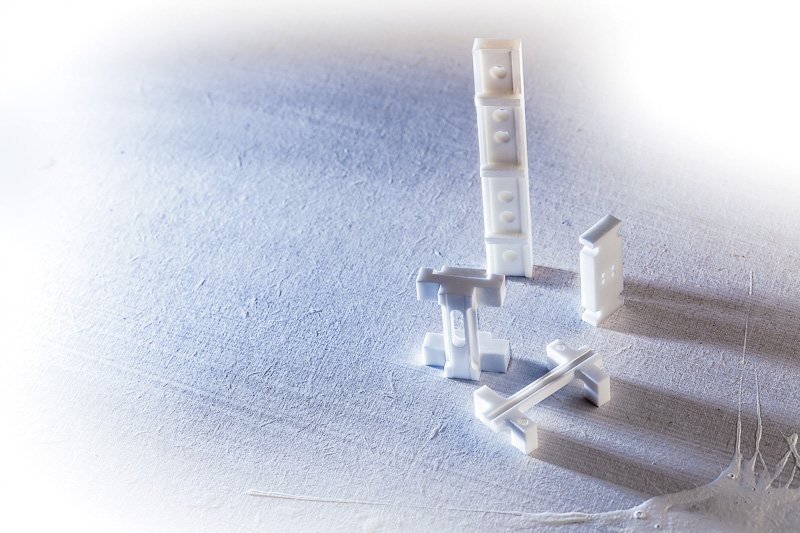
Those who align tolerance concept and geometry early avoid grinding rework and scrap at small batch sizes.
a few µm
achievable manufacturing tolerance through grinding and lapping after firing.
> 10 %
sintering shrinkage during firing. Final dimensions are achieved through hard machining, not through the sintering process.
< 0.5 mm
realised diameter of push rods made from ZrO₂.
M1.2
through-hole internal threads in a component measuring 2.5 × 2.5 × 12 mm made from A-997.
non-magnetic
ZrO₂ and Al₂O₃ do not interfere with electronic or magnetic measurements.
Answers to typical questions on tolerances, minimum dimensions, electrical insulation and dimensional stability of ceramic micro components.
What tolerances are achievable with ceramic micro components?
Tolerances in the µm range are achievable, but not directly from the sintering process. Ceramics shrinks more than 10 % during firing; sintered alone, dimensions are typically within approximately one to two percent. Tight final tolerances are achieved through hard machining after firing – that is, through grinding, lapping and polishing. Which tolerance is functionally necessary and economically sensible is clarified before the quote based on function and geometry.
What minimum dimensions are possible with ceramic micro components?
Realised examples include push rods with a diameter below 0.5 mm and through-hole M1.2 internal threads in components of just a few millimetres edge length. This is made possible by ultrasonic-assisted CNC grinding, supplemented by green machining for geometries that cannot be produced by grinding alone. Available as prototypes, small series or custom-made components to customer drawings.
Are ceramic micro components electrically insulating and non-magnetic?
Yes. Oxide ceramics such as ZrO₂ and Al₂O₃ provide reliable insulation and are non-magnetic. This is relevant in sensor technology, measurement technology and semiconductor handling. For ultra-high vacuum, BCE offers suitable materials such as A-997: no relevant outgassing, electrically insulating and mechanically stable down to the µm range.
How is dimensional stability maintained throughout the entire service life?
With ceramic precision components, maintaining dimensional stability throughout the service life is the actual design challenge. ZrO₂ does not lose its geometry through abrasion the way hardened steel does, because its hardness is significantly higher. What is nonetheless decisive is the material pairing in contact: a ceramic against a surface that is too soft can abrade it. The design of the tribological pairing is part of the material consultation before the quote.
What does M1.2 mean – and why is it a demanding thread in ceramics?
M1.2 is a metric thread designation according to ISO: the number indicates the nominal diameter in millimetres. An M1.2 thread therefore has an outer diameter of only 1.2 mm – roughly as fine as the lead of a mechanical pencil. In steel it can be produced with a tap; in ceramics it cannot: the brittle material would fracture during conventional thread cutting. Such threads are produced at BCE either through green machining before firing or through specialised hard machining. Six through-hole M1.2 threads in a component measuring 2.5 × 2.5 × 12 mm illustrate how precisely BCE manufactures in the field of microsystem technology.
A brief conversation is enough to assess feasibility and material.